
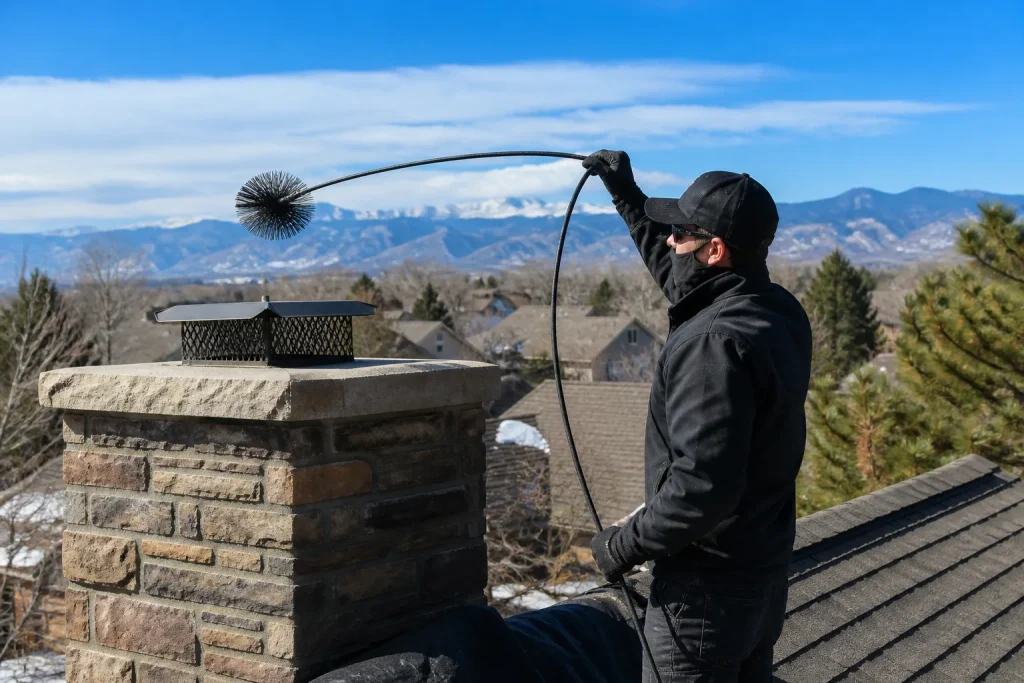
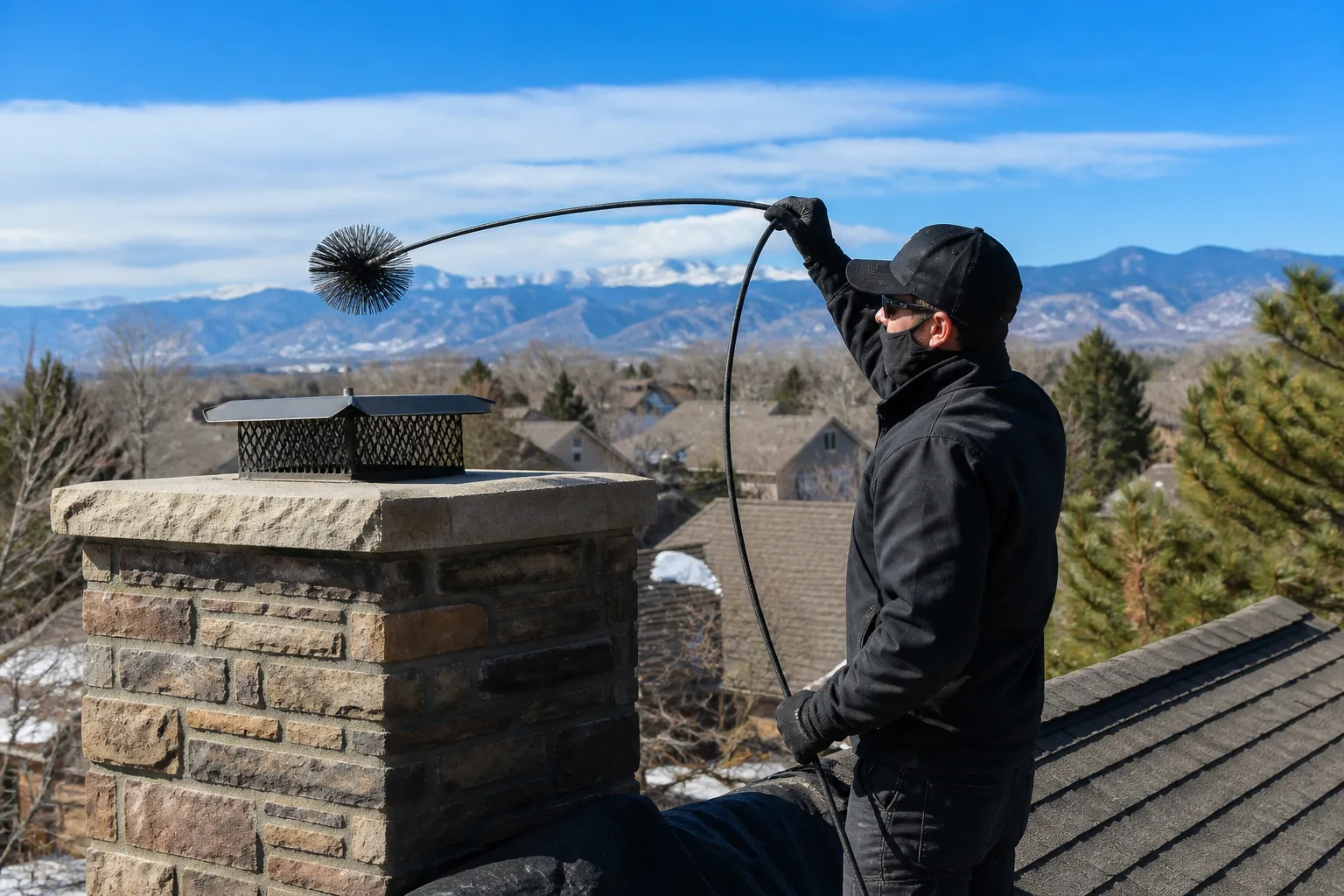
Emergency Chimney Sweep Near Me: What Centennial Homeowners Should Do First
If you think you’re having a chimney fire, call 911 first, then get everyone out of the house. If the problem is heavy smoke or a carbon monoxide alarm, get outside and ventilate before you touch anything. The first 15 minutes matter more than any phone number you have saved: how you respond in those minutes decides whether a chimney problem in Centennial stays contained or turns into a structural or life-safety event. If you’d rather have a trained eye walk through it with you, call (833) 842-2139. We answer 24/7.
Most homeowners who’ve had a chimney fire describe the sound as a freight train running through the roof. That’s the loud kind. The quieter and far more common kind is the slow-burn chimney fire that runs at lower temperatures for hours with no sound at all, and it can leave a flue looking fine from the fireplace while the inside is compromised. This guide is a decision tree, not just a phone number.
What’s the first thing to do in each chimney emergency? Three scenarios, three different first moves
Treat the three common chimney emergencies as separate events, because the right first action is different for each one. Mixing up the response is the most common mistake we hear about, so start by naming which situation you’re actually in.
Scenario 1: Active chimney fire
- Get everyone out of the house and call 911. This is the first move, not the last.
- If you can do it safely, close the fireplace glass doors or the firebox door. This limits air feeding the fire.
- Do not pour water on it. A sudden cold shock on hot masonry or a metal liner can crack it.
- Stay out until the fire department clears the chimney. A loud roaring sound, a dense draft of heat, or visible flames at the top of the chimney all mean the fire is active.
- Do not use the fireplace again until a proper inspection has happened. More on that below.
Scenario 2: Persistent smoke intrusion
- Open a window in the room closest to the fireplace to relieve negative pressure.
- Check that the damper is open. A closed or partly closed damper is the cause more often than people expect.
- If smoke is pouring back into the room with the damper open and the fire is burning, put the fire out with a fire extinguisher designed for solid fuels and step outside.
- Call us or your local fire department if the smoke is thick or the smell is harsh, and do not assume it’s a minor draft problem without a camera check of the flue.
Scenario 3: Carbon monoxide alarm activation
- Get everyone outside into fresh air and call 911. That’s it. Do not open windows and stay inside to “air it out.”
- Do not restart any gas appliance until the source has been found and cleared.
- When the emergency is over, book an inspection. A CO alarm on a gas fireplace or boiler flue usually means a blocked or compromised vent, and that needs camera evidence, not a guess.
Those first moves are your job. Diagnosing the cause is ours. If you’re in Centennial and need someone to look at the flue after any of these, a chimney sweep with a camera and proper training can tell you what actually happened.
Does closing the damper during a chimney fire help or hurt?
Closing the damper can help, but it’s not a magic switch and it’s not always the right call. Chimney fires need three things to keep running: fuel, heat, and oxygen. The damper controls the oxygen side of that triangle, at least the air coming up through the firebox. Closing it starves the fire, which is often useful. But closing a damper with a fire already roaring up the flue can also push heat and pressure into other parts of the chimney or into the house, especially if the damper doesn’t seal tightly. That’s why most fire crews will tell you not to risk yourself getting to a stuck damper. Our rule: close it only if it moves freely and you can do it without leaning into the firebox. Otherwise, get out and let the fire department handle it. Never close the damper and assume the fire is out. Smoke can keep smoldering behind it. The damper/oxygen dynamic is a big part of why we tell Centennial homeowners not to treat a smoldering fire as “done” without a proper look at the flue afterward.
When to call a pro: anything involving a stuck damper, a damper that hasn’t moved in years, or smoke that persists after the fire is out is a same-day call to us, not a wait-and-see.
What must a post-fire inspection include before you use the fireplace again?
A post-fire inspection must include at least an NFPA 211 Level 2 inspection before the fireplace can be used again. That means a camera inspection of the full flue, not a flashlight look up the firebox. A visual check from a non-specialist is not enough, and here’s why: the damage a chimney fire causes is usually on the inside surface of the flue liner, where a glance from the hearth can’t see.
A proper post-fire inspection in Centennial includes:
- A full-length camera scan of the flue from the firebox to the top of the chimney
- A check of the clay tile or liner joints for cracks, gaps, and flaking
- A check of the chimney cap, crown, and flashing for heat damage
- Photos provided to you, so you can see what the technician sees
- A written summary of what’s found and what it means for safe use
A chimney inspection is the only honest way to know what your flue needs. We use professional-grade brands like Olympia Chimney and Gelco for the components involved in that inspection and repair work, because it’s what professionals rely on, not what’s cheapest to stock. If the inspection finds liner damage, the repair is diagnosed before it’s recommended, and you get to see the evidence for yourself before anything is booked.
What happens to a chimney after an undetected fire? The structural timeline
An undetected chimney fire can leave a flue that looks intact but is compromised beyond safe use. That’s the part homeowners find hardest to believe. Here’s the timeline in plain terms.
Minutes into the fire: flue gas temperatures in a chimney fire can reach 2,000°F and higher. Standard clay tile liners are not built for sustained temperatures at that level.
Hours after the fire: the clay tiles can crack and the mortar joints between them can fail. Some of the damage is hidden behind soot.
Days to weeks later: cracked tiles open gaps that let hot gas and embers reach the framing and insulation around the chimney. That’s the dangerous phase because the fire is out and the hazard isn’t.
Months later: a small crack can widen. Creosote that survived the fire can re-ignite, and the next fire starts from a compromised liner. In our experience, that’s how a “small” fire turns into a real one.
If your chimney has had an undetected fire, you cannot rely on how it looks from the hearth. You can rely on a camera scan. If a liner needs repair, we work with systems like HeatShield resurfacing and DuraFlex flexible liners, and a full chimney repair plan is written from what the camera actually shows.
What can a same-day emergency chimney sweep in Centennial actually do?
A same-day emergency chimney service in Centennial can get eyes on your flue and stop the immediate hazard. It can sweep the firebox and flue, run a camera inspection, document what it finds with photos, and tell you plainly whether the fireplace can be used again and what needs to happen next. What it cannot do is rebuild a cracked flue liner or replace a fire-damaged chimney crown in the same visit.
Here’s what to expect on a call in Centennial:
- A sweep and camera inspection the same day a slot is open
- A photo report you keep
- A written estimate for any repair that the inspection shows is needed
- A clear answer on whether the fireplace is safe to use right now, and what to do in the meantime if it isn’t
- No pressure to book repair work that can safely wait, and no guesswork in place of a camera view
Related services in Centennial: if the flue looks sound after inspection but the cap, damper, or venting components are worn, we handle those with Famco and Copperfield parts as part of the same visit scope. That’s the benefit of working with a single provider that sweeps, inspects, and repairs: findings never get passed off to a stranger.
One light note from the field: most “emergency” calls we get in Centennial turn out to be a closed damper and an overfilled firebox. We’ll take the call either way, but if you can’t remember the last time you opened that damper, check before you panic.
The Bottom Line
In a chimney emergency, your first job is safety, not diagnosis. Get out of the house, call 911 for a fire or a CO alarm, and don’t run the fireplace again until a full camera inspection has cleared the flue. A post-fire inspection at NFPA 211 Level 2 is the minimum, and a “looks fine” glance from a non-specialist is not enough. An undetected fire can compromise a flue at 2,000°F and leave it looking intact from the hearth. If you’re in Centennial and need help, Chimney Sweep Centennial offers free estimates. Call (833) 842-2139. We answer 24/7. Fast dispatch from 7am to 7pm, Sunday through Friday. You can also visit our homepage at Chimney Sweep Centennial to see what we handle, or learn more about the area we serve around Centennial. Our technicians have up to 13 years of experience, and every sweep is booked with a flat price agreed before we arrive.
Frequently Asked Questions
Yes, in most cases a same-day sweep and camera inspection is possible in Centennial. Call (833) 842-2139 and we’ll book the next open dispatch slot, and we’ll tell you on the phone whether the fireplace should stay off until then. The sweep gets your flue clean enough to inspect; the camera view and photo report tell you what actually happened.
A sweep alone isn’t enough after a fire. A sweep removes soot and creosote so the liner can be seen. The inspection is what finds cracks, failed joints, and heat damage, and that requires a camera that runs the full length of the flue. We include a camera inspection and photo report with the visit so you can see the condition of your liner for yourself.
A loud chimney fire is obvious: roaring, popping, or a sound like a train through the roof. A slow-burn chimney fire runs at lower temperatures for hours with no sound at all, and it’s far more common. Both can damage the liner, which is why any fire, loud or quiet, needs a camera inspection before the fireplace is used again.
Book an inspection before you use it again. That’s true for any Centennial home where the chimney’s service history is unknown, especially an older one. A camera inspection shows the actual condition of the liner, cap, damper, and venting, and a written estimate follows only if the findings call for it. Call (833) 842-2139 for a free estimate.
Written by the team at Chimney Sweep Centennial.
Need Chimney Cleaning Help?
Call Chimney Sweep Centennial - licensed & insured, with free written estimates in Centennial.
(833) 842-2139